
At Series A, Customer Acquisition Stops Being Your Biggest Problem
When you are at Pre-Seed and Seed, your mandate is simple: survive.
You hustle for visibility, burn cash on performance clicks, run hyper-aggressive discounts, and hunt for any transactional traction just to prove a basic product pulse. You talk about user growth because that’s all you have.
But the moment you cross into Pre-Series A and Series A territory, the rules don't just change — they completely invert.
If you walk into a Series A presentation room with nothing but a high-volume performance marketing dashboard and a flashy user acquisition chart, sophisticated institutional investors will look right past it.
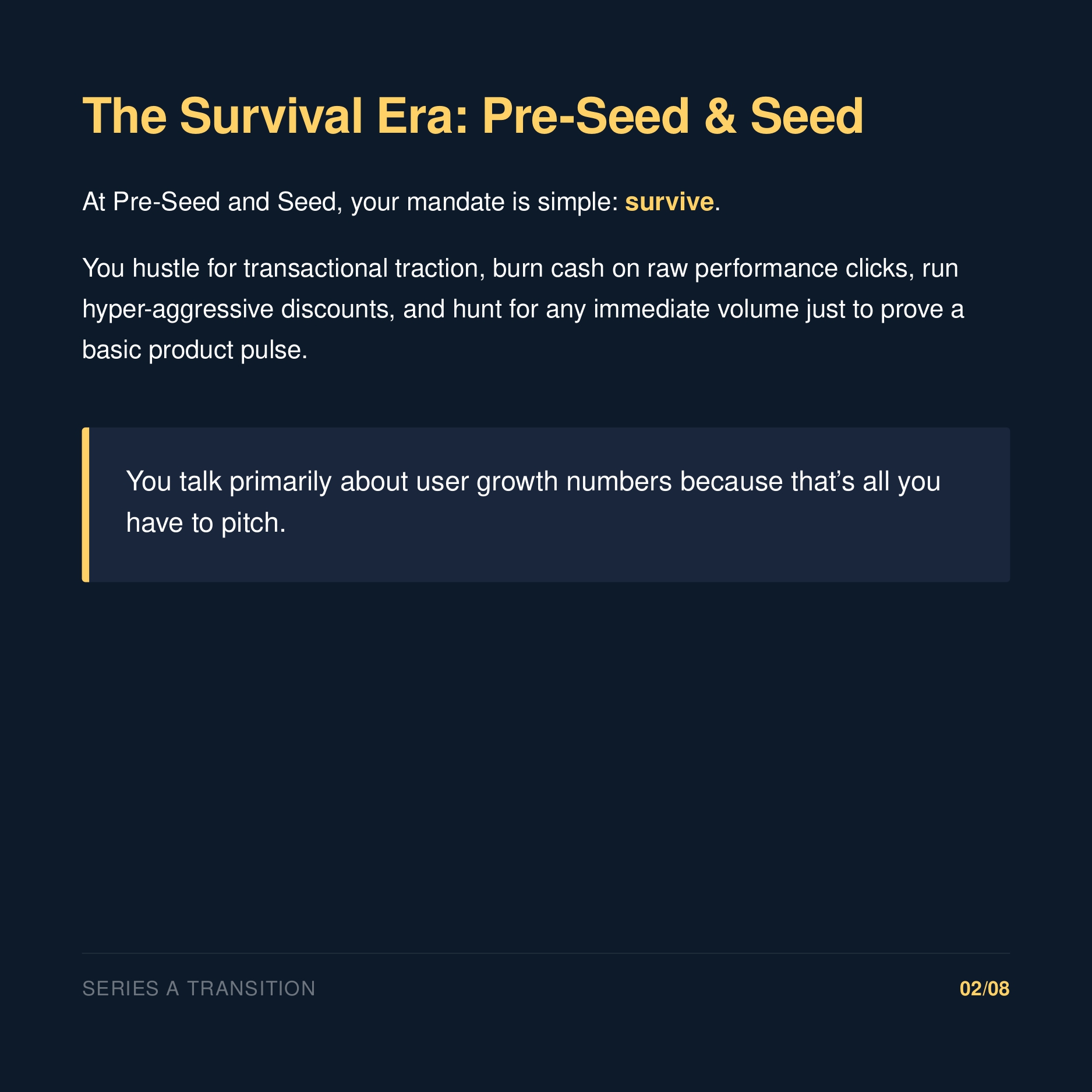
The Survival Era: Pre-Seed & Seed
At the early stage, survival is the mandate.
Startups optimize for:
- Visibility
- Transactional traction
- Immediate growth
- Paid acquisition velocity
The goal is simple: prove the market responds.
But survival-stage tactics cannot become long-term operating strategy.
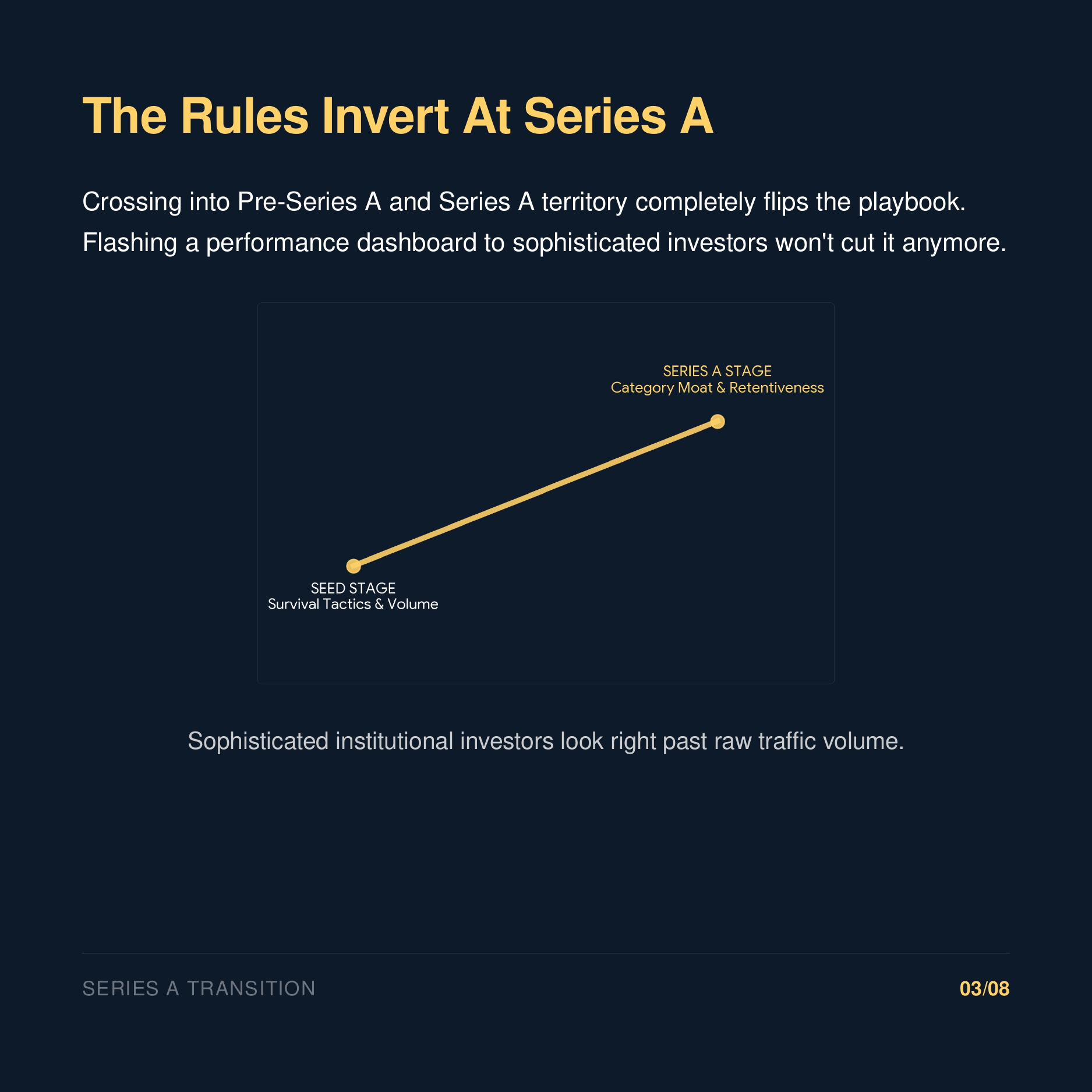
The Rules Invert at Series A
At Series A, acquisition alone loses strategic value.
Why?
Because acquisition is replicable.
Competitors can:
- Copy your ad creatives
- Outbid your keywords
- Clone your funnel
- Match discounts instantly
Performance marketing is not a moat.
It is simply rented visibility.
Institutional investors now evaluate something deeper:
- Category authority
- Retention strength
- Brand defensibility
- Predictable expansion economics

Acquisition Becomes a Commodity
Scaling paid acquisition without building brand equity creates a dangerous dependency loop.
You become trapped paying increasing CAC just to maintain attention.
That creates three major risks:
1. Fragile Growth
Growth collapses the moment spend decreases.
2. Weak Market Positioning
Customers buy because of discounts — not conviction.
3. No Structural Moat
Nothing prevents competitors from replacing you.
The strongest Series A companies stop renting attention and start owning trust.

The Series A Risk Matrix
At this stage, the conversation shifts toward structural business quality.
Differentiation
Do customers buy from you because you are cheaper — or because you are the category leader?
Predictability
Is your Net Revenue Retention (NRR) consistently above 100%?
Governance
Does your brand architecture reduce blended CAC over time?
Sophisticated investors are evaluating whether your startup can scale predictably without endlessly increasing acquisition burn.
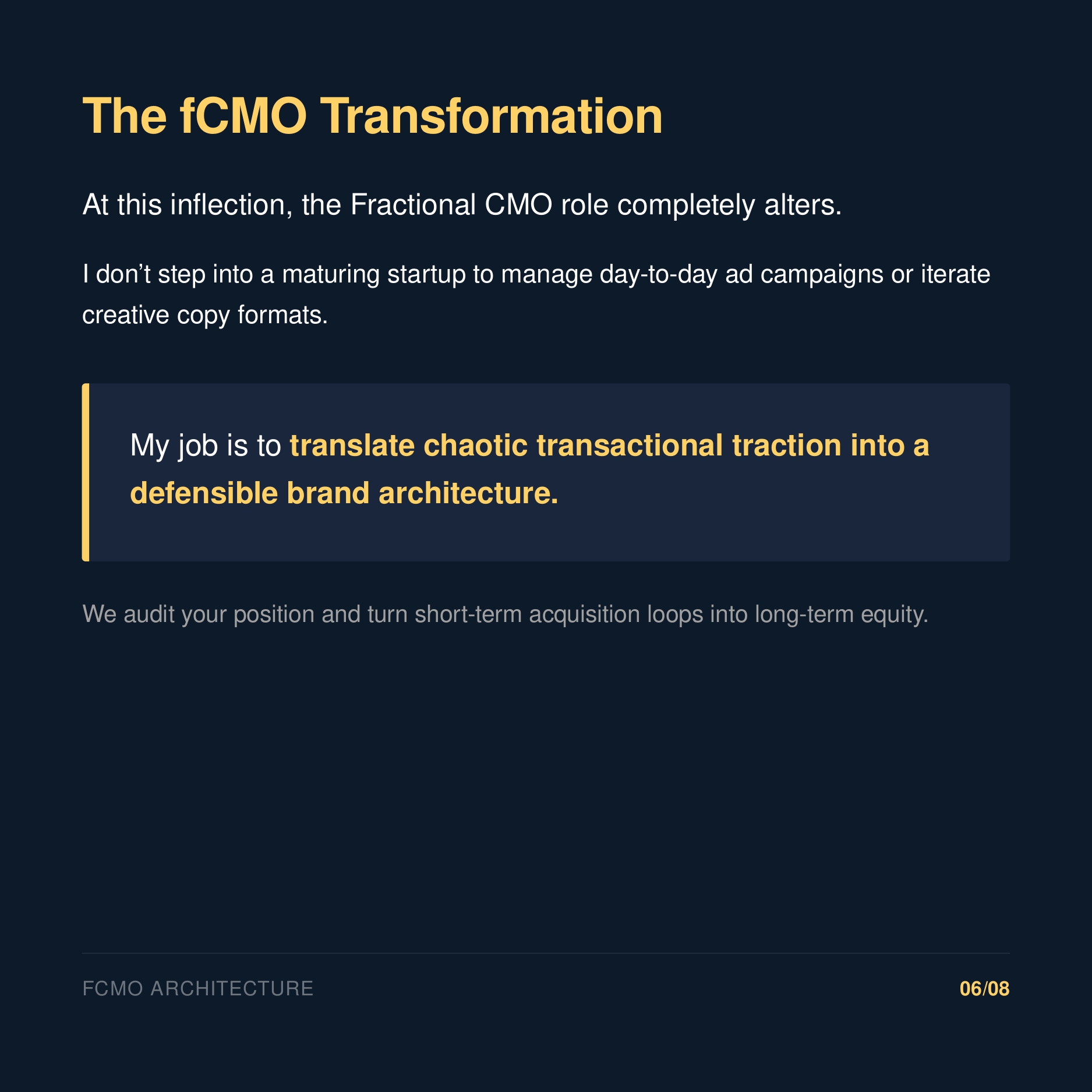
The Role of the Fractional CMO Changes Completely
At this stage, a Fractional CMO is no longer managing ad campaigns.
The responsibility becomes far more strategic.
The objective shifts toward:
- Building category positioning
- Creating narrative authority
- Designing scalable GTM systems
- Translating transactional traction into long-term brand equity
This is where operational marketing becomes institutional growth architecture.
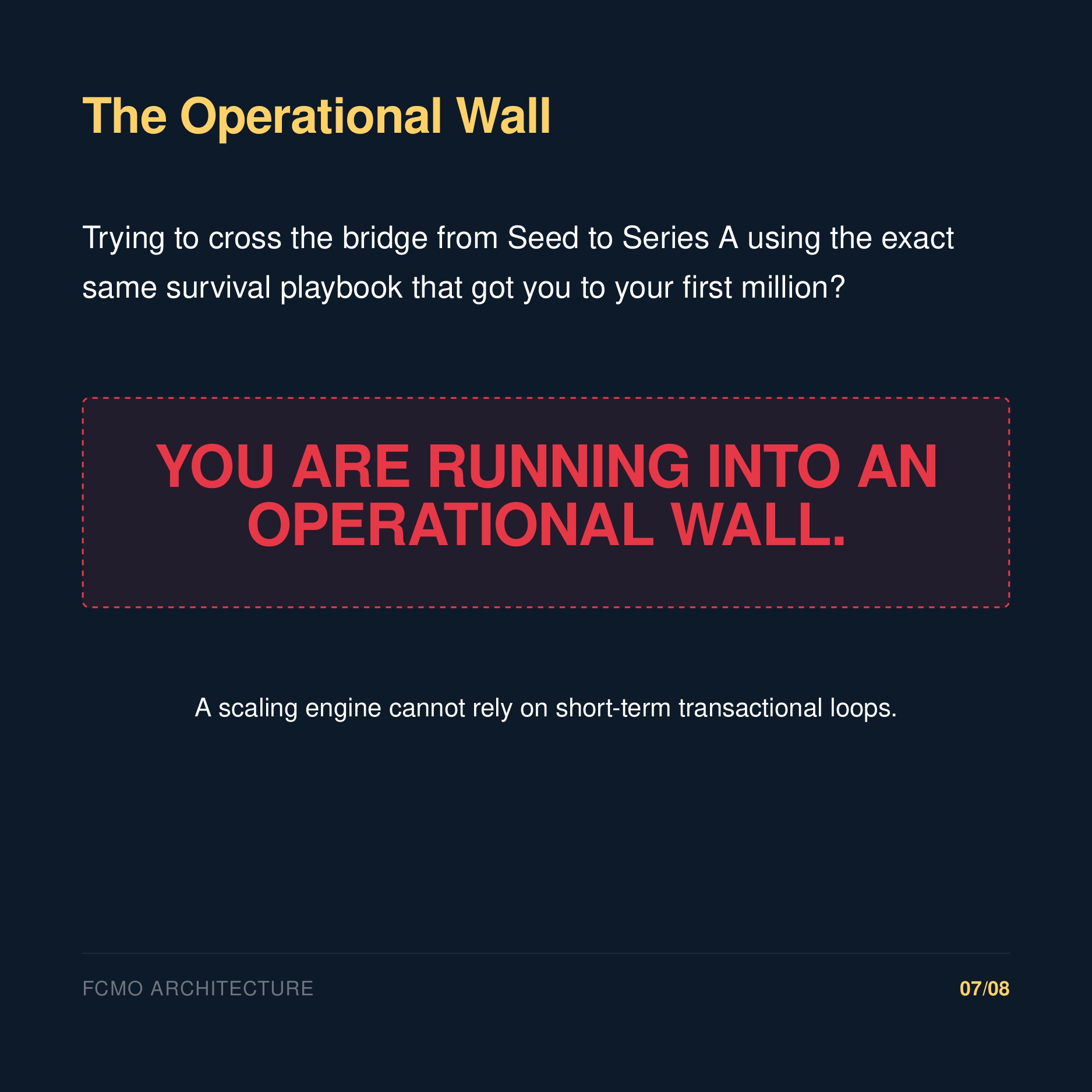
The Operational Wall
Many startups attempt to cross from Seed to Series A using the exact same tactics that helped them survive early-stage chaos.
That creates an operational wall.
A scaling company cannot depend entirely on:
- Short-term acquisition loops
- Constant discounting
- Performance dependency
- Volume-only growth
Without strategic brand infrastructure, scaling eventually slows, CAC increases, and differentiation collapses.

Build Your Structural Moat
The transition from Seed to Series A is not just about growing faster.
It is about becoming structurally stronger.
The goal is to evolve from:
- Transactional traction
- Temporary visibility
- Paid dependency
Into:
- Category authority
- Institutional trust
- Predictable revenue expansion
- Long-term market defensibility
If your startup is approaching this transition point, now is the time to build the operational and brand systems that institutional investors expect.
Let’s turn surface-level vanity metrics into scalable, high-conviction growth.
Book a Strategic GTM Review
👉 abhrabanerjee.com
#SeriesA #StartupGrowth #FractionalCMO #BrandEquity #GoToMarket #ExecutiveLeadership