From “We’re Getting Leads!” to “Why Aren’t We Closing?”
The Hidden Early-Revenue Trap for Pre-Seed & Seed Startups

If you read my last post, you know how dangerous it is to treat early-stage capital like a megaphone.
But let’s look at what happens right after a Pre-Seed or Seed-stage startup fixes that mistake.
You narrowed your focus.
You built your early Go-to-Market foundation.
Suddenly, the indicators look great:
- Top-of-funnel traffic is climbing
- Lead forms are buzzing
- Demo requests are increasing
The founder’s instinct here is to celebrate.
But then you look at your sales pipeline, and a cold reality sets in:
Your calendar is full of demos, but your bank account isn’t seeing the cash.
The Illusion of Growth

Early traction can feel like validation.
Traffic spikes.
More leads enter the funnel.
Your team becomes busy.
But activity does not always mean momentum.
Many startups mistake pipeline volume for pipeline quality.
And that confusion becomes dangerous when runway pressure starts increasing.
The Early-Revenue Trap: Pipeline Leakage
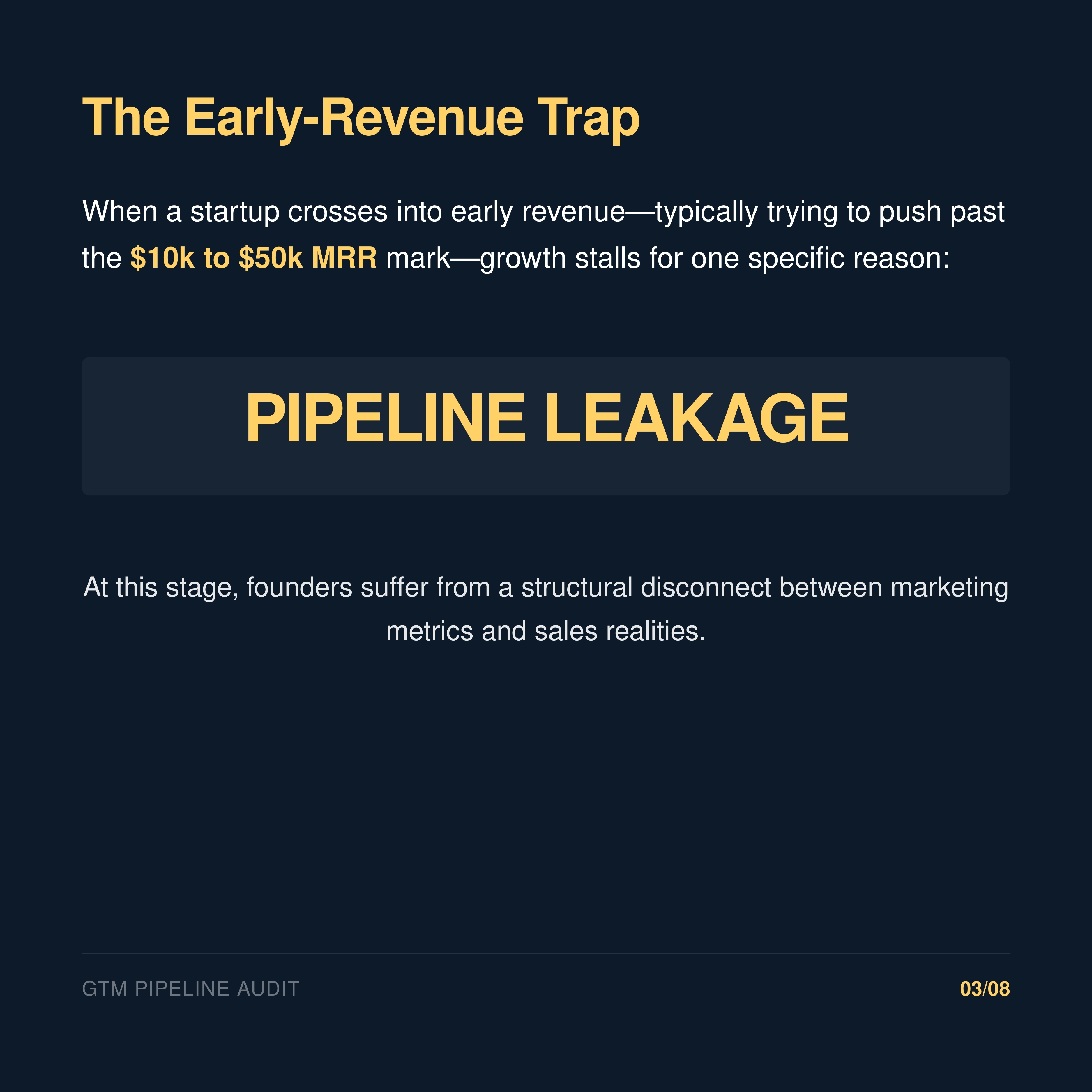
When a startup crosses into early revenue — typically trying to move beyond the $10k to $50k MRR stage — growth stalls for one specific reason:
Pipeline Leakage
At this stage, founders suffer from a disconnect between marketing metrics and sales realities.
The surface-level numbers may look healthy.
But underneath, conversion efficiency collapses.
3 Symptoms of Mismatched Intent

1. The Ghost Lead Syndrome
Marketing generates high volumes of “leads” through downloadable guides, generic webinars, or broad campaigns.
But Sales cannot get them on a call.
The leads are curious.
Not committed.
2. The “Nice to Have” Feedback Loop
Your team runs great demos.
Prospects say:
“This looks amazing. Let me discuss this internally.”
But they never buy.
Why?
Because your messaging attracted researchers — not economic decision-makers.
3. The Churn Spike
Even when you close early revenue, those users churn within 60 to 90 days.
Why?
Because they were acquired through misaligned positioning and weak expectation management.
The promise that brought them in was not the reality they experienced.
Injecting GTM Pipeline Discipline
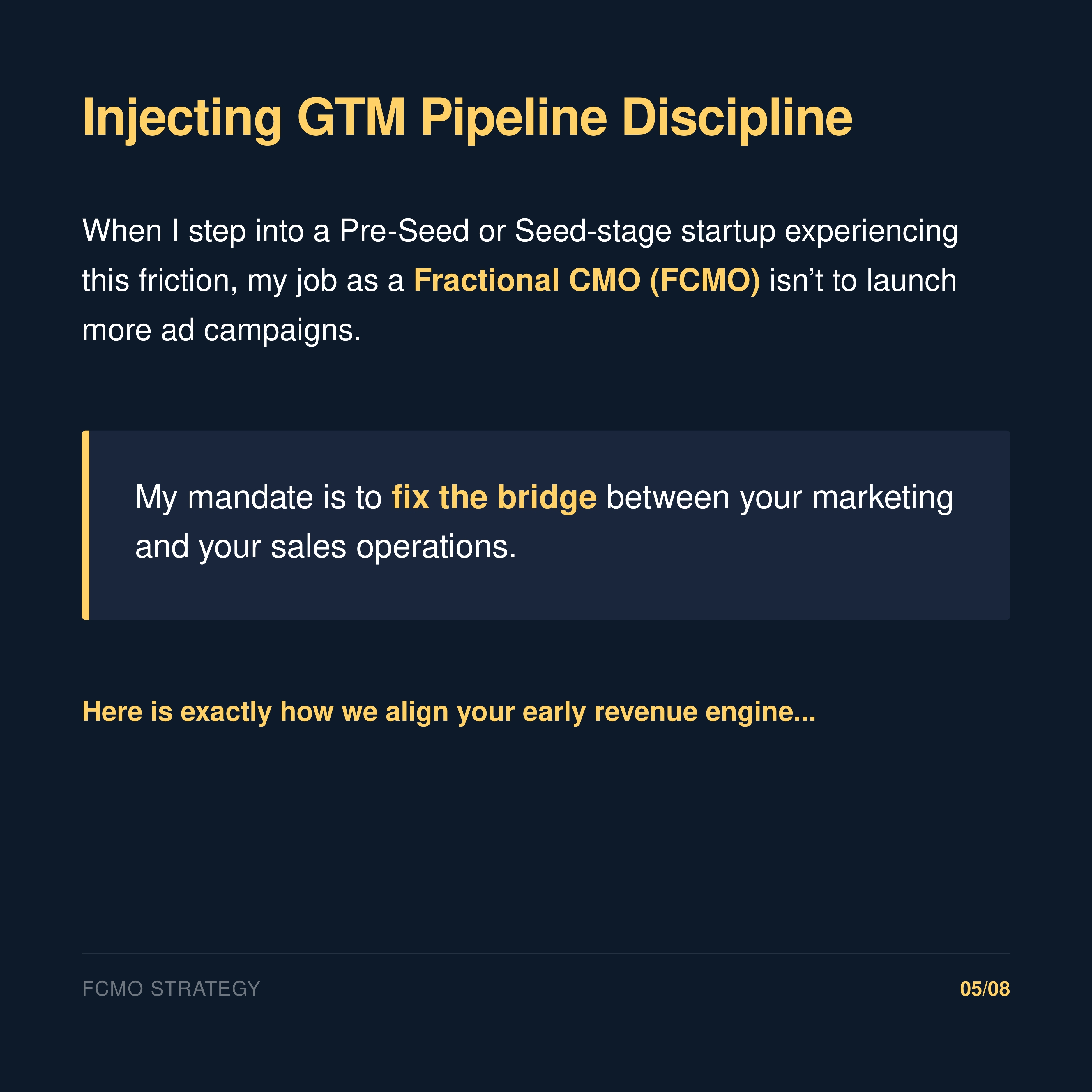
When I step into a Pre-Seed or Seed-stage startup experiencing this friction, my role as a Fractional CMO (FCMO) is not to launch more ad campaigns.
It is to fix the bridge between your marketing and sales operations.
That bridge determines whether growth compounds — or leaks.
Fixing the Revenue Engine

From Features to Business Outcomes
We audit your messaging matrix.
We shift your positioning away from explaining features and toward solving measurable business pain for the person controlling the budget.
Because buyers do not purchase software.
They purchase outcomes.
Marketing and Sales Synchronization
We establish a clear Lead-to-Opportunity framework.
Marketing is no longer evaluated by:
- Clicks
- Impressions
- Form fills
Instead, it is measured by:
- Qualified pipeline value
- Opportunity creation
- Revenue contribution
That alignment changes how the company scales.
Operations Built to Scale
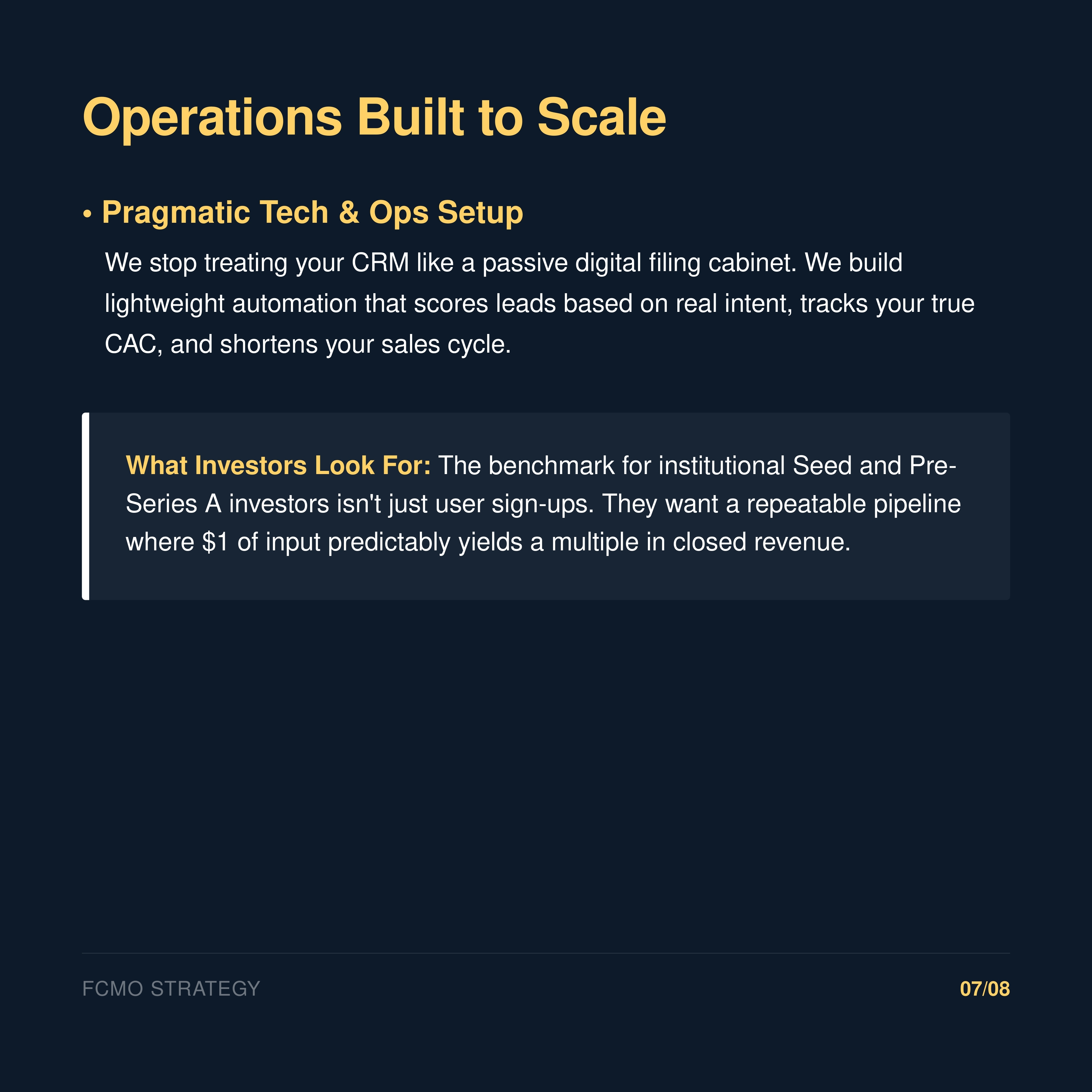
We stop treating the CRM like a passive digital filing cabinet.
Instead, we build lightweight operational systems that:
- Score leads based on buying intent
- Track real CAC
- Identify funnel leakage
- Shorten sales cycles
- Improve conversion predictability
This is what institutional Seed and Pre-Series A investors actually want to see.
Not vanity metrics.
Not inflated lead counts.
They want a repeatable pipeline where:
$1 of input predictably creates multiple dollars in closed revenue.
Scaling Revenue or Just Making Noise?

If your team is running demos nonstop but your Monthly Recurring Revenue is plateauing, you do not have a volume problem.
You have an alignment problem.
The goal is not more noise.
The goal is predictable, high-conviction revenue.
Let’s Audit Your GTM Pipeline
Let’s turn surface-level vanity metrics into scalable revenue systems that position your startup for the next round of funding.