The EdTech Differentiation Crisis Has Already Begun
Why “Results” Are Now Just the Starting Point
Scaling student outcomes is no longer enough to build a category leader.
In 2026, results are the baseline—not the differentiator.
Every EdTech platform claims:
- High success rates
- Better outcomes
- Faster learning
And when everyone says the same thing…
The market stops listening.
We are entering the era of:
🚀 Perception-led growth
You See Results. The Market Sees Noise
Why Data Alone No Longer Builds Trust
Most founders believe acceptance rates = competitive moat.
But when every competitor claims 95% or 99%,
those numbers lose their power.
What actually drives decisions today?
- Authority
- Trust
- Positioning clarity
Trust is built on authority—not just data points.
Why “Better” Is the Enemy of “Different”
Understanding Real Buyer Psychology
Parents aren’t searching for the fastest platform.
They are looking for:
- Safety
- Certainty
- Predictability
If your messaging is purely logical or technical,
you miss the real emotional trigger:
“Will this secure my child’s future?”
That’s where most EdTech brands lose.
What Is Your Actual Competitive Moat?
The 3 Levels of EdTech Differentiation
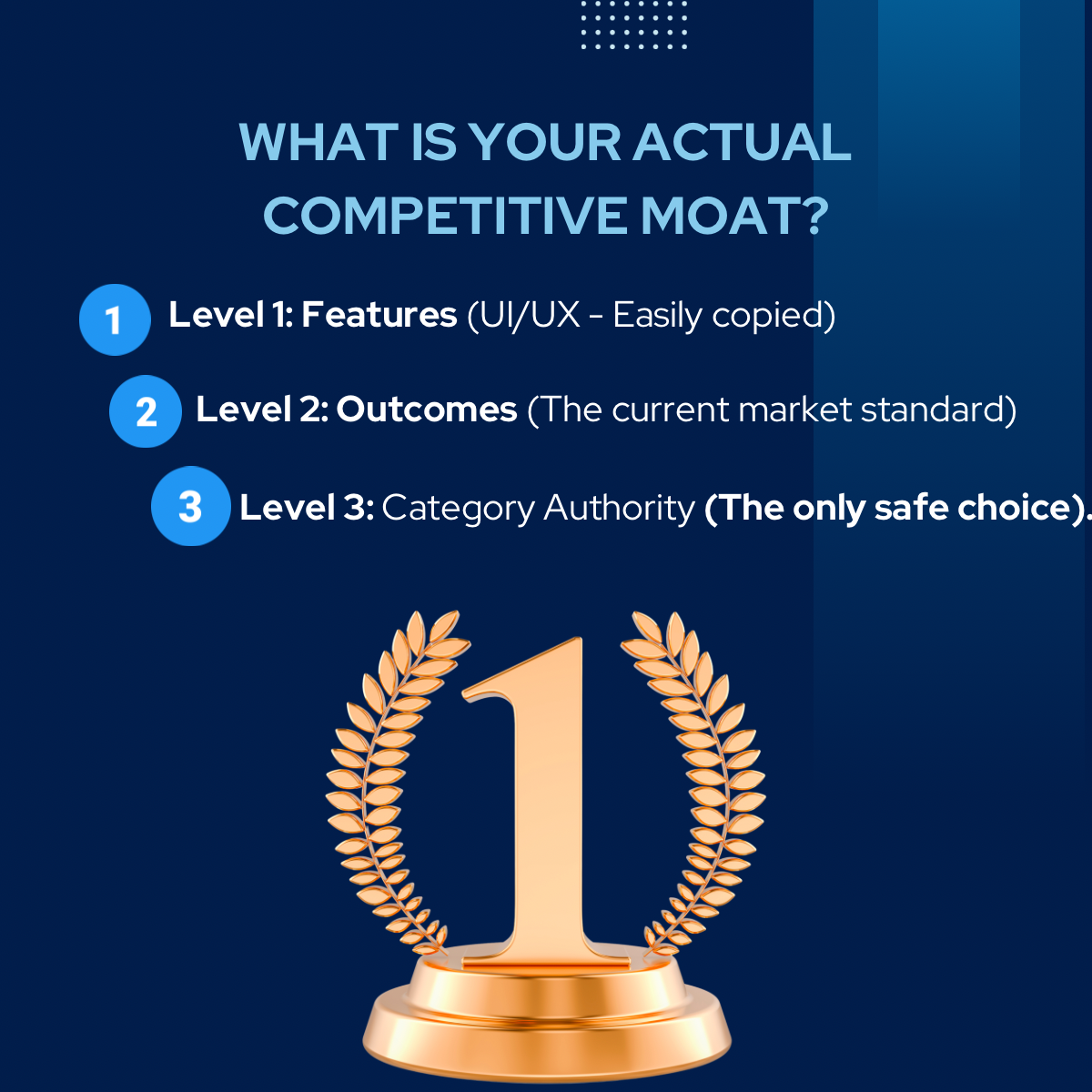
Level 1: Features
(UI/UX, dashboards — easily copied)
Level 2: Outcomes
(Current market standard)
Level 3: Category Authority
👉 The only sustainable moat
This is where:
- You become the default choice
- Price becomes irrelevant
- Trust compounds over time
If Your Curriculum Is on YouTube, You’re a Commodity
Why Information Alone No Longer Sells

Information is free.
Transformation is not.
If you’re selling:
- Recorded lectures
- Course libraries
You are competing with free content.
Instead, build:
- A Proprietary Process
- A Transformation Journey
- A System people can’t replicate
This is how you evolve from:
Tuition Center → Career Architect
The Bigger Shift: From AI Chatting to AI Execution
Why Conversational AI Is No Longer Enough
For the last two years, AI has been used for:
- Writing content
- Generating ideas
- Supporting workflows
But in 2026:
Chatbots are not enough. You need operators.
We are moving from:
- Insights → Action
- Assistance → Execution
- Tools → Systems
The Hidden Problem: The “Franken-Stack”

Most businesses operate with:
- Multiple tools
- Poor integrations
- Manual workflows
Even with AI, nothing truly moves.
That’s why founders feel:
“We have AI… but no real growth.”
The New Advantage: A Unified Nervous System
How Modern Businesses Actually Scale

The winners in 2026 won’t be those with more tools.
They will be those with:
Better-connected systems
Where:
- CRM
- Marketing
- AI
- Operations
Work together as one intelligent system.
How to Build a Real EdTech Moat in 2026
1. Audit Your Outcome-to-Trust Ratio
Are you proving results—or building belief?
2. Define Your “Only-ness”
Why should someone choose you over everyone else?
3. Align Perception With Reality
Use storytelling to control the narrative.
4. Move From AI Tools to AI Systems
Stop using AI for content. Start using AI for execution.
Final Thought
Most EdTech brands will spend another year competing for the same average student.
The leaders will do something different.
They will build:
- Authority
- Trust
- Systems
And create a brand people fight to join.
🚀 Free EdTech Growth & AI Audit
Want to identify:
- Your positioning gaps
- Your differentiation strength
- Your AI execution readiness
👉 Book a Free 15-Minute Strategy Audit
Are you still using AI to talk?
Or are you ready to make it execute?