The Growth Killer: Why Your “Full-Stack” Marketer is Stagnating ROI
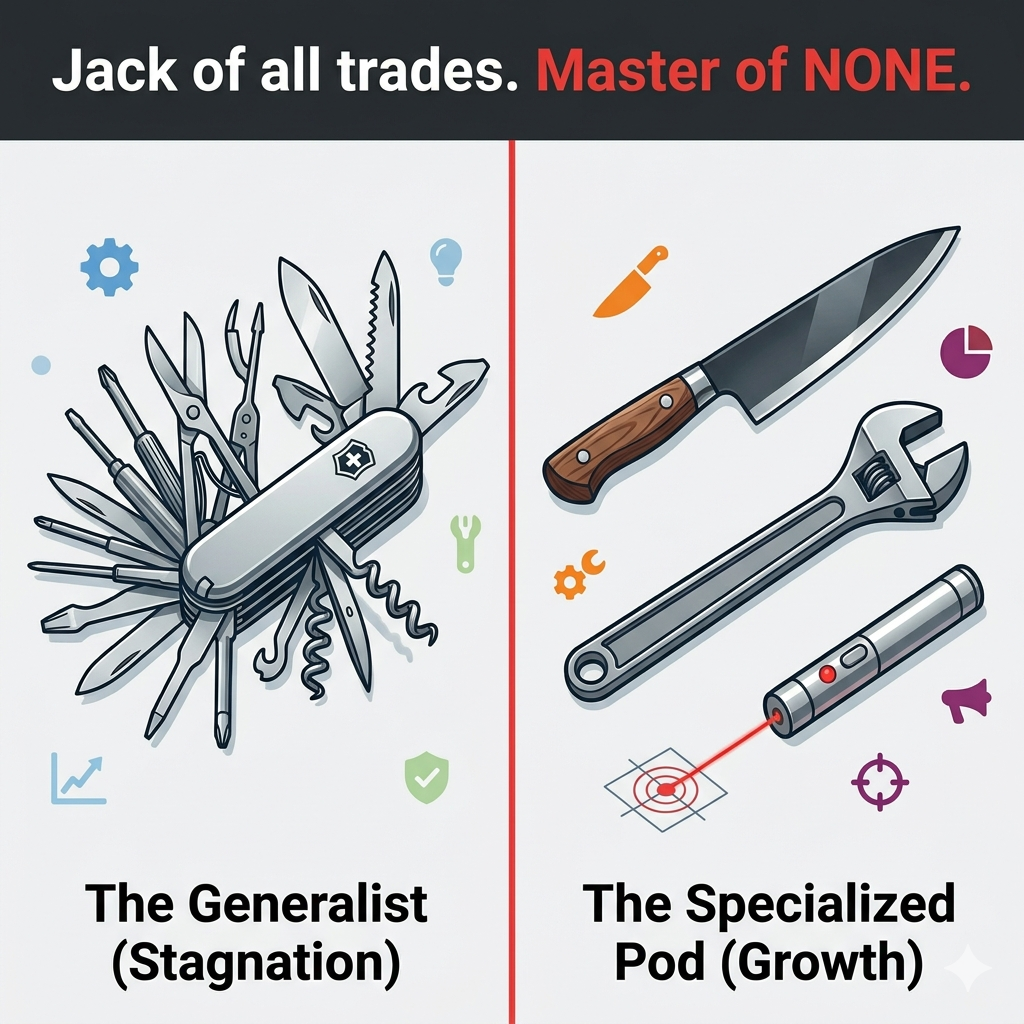
In the early stage of a business…
A generalist feels like a superpower.
One person handling:
- SEO
- Ads
- Copy
- Analytics
- Design
- Automation
Seems efficient.
But as your company grows…
That same model quietly becomes:
A growth bottleneck.
Because scaling is not about doing everything.
It is about doing critical things exceptionally well.
The Hidden Cost of the “Full-Stack” Model
Most founders believe hiring one versatile marketer saves money.
But the real cost is invisible.
When one person constantly switches between:
- CSS fixes
- Brand storytelling
- Performance ads
- SQL dashboards
Depth disappears.
And shallow execution creates:
→ Weak market positioning
→ Inconsistent acquisition
→ Stagnant ROI
The Problem with Generalized Marketing
Generalists are valuable for survival.
But not dominance.
Because modern markets reward:
Specialization
Not multitasking.
When one marketer owns the entire funnel…
You usually get:
- Surface-level SEO without topical authority
- Generic messaging that blends into the market
- Reporting dashboards without strategic insights
- Campaigns without positioning clarity
The result?
Activity without momentum.
Why Scaling Requires Depth
As competition increases…
Execution quality becomes the differentiator.
A specialist sees what a generalist misses.
Because expertise compounds.
An SEO strategist understands:
- Search intent
- Topical clustering
- Authority architecture
A conversion copywriter understands:
- Buyer psychology
- Friction points
- Narrative positioning
A performance marketer understands:
- CAC efficiency
- Attribution
- Scaling thresholds
Growth happens when these functions work together.
Not when one person tries to juggle all of them.
The Smarter Model: T-Shaped Teams
The highest-performing brands do not rely on marketing unicorns.
They build:
Specialized systems
A modern growth structure looks like this:
→ Strategic Leadership
Defines:
- Positioning
- Growth roadmap
- Market differentiation
→ Specialized Execution
Experts handle:
- SEO
- PPC
- Content
- CRO
- Analytics
→ Data-Driven Iteration
Systems identify:
- What converts
- What scales
- What should be eliminated
This creates:
- Faster optimization
- Lower CAC
- Stronger authority
- Predictable growth
Brands scaling efficiently today rely on integrated growth systems—combining analytics, automation, campaign intelligence, and specialized execution instead of depending on a single “full-stack” marketer.
Platforms like Cleanomatics Laundry Technology Platform reflect this shift toward scalable marketing infrastructure.
Versatility Does Not Scale Performance
The market romanticizes the “full-stack marketer.”
But businesses do not grow from versatility alone.
They grow from:
Focused expertise aligned under strategic direction
One exceptional specialist can outperform:
- 10 average campaigns
- 100 random content pieces
- Months of scattered execution
Because clarity scales.
Chaos does not.
The Real Question Founders Must Ask
Are you building:
→ A marketing function?
Or
→ A growth engine?
There is a difference.
One produces activity.
The other produces:
- Revenue
- Market authority
- Compounding ROI
Final Thought
A full-stack marketer may help you start.
But specialists help you scale.
The companies dominating today are not winning because they “do more.”
They win because:
Every part of their growth system is strategically engineered for impact.
Stop hiring for convenience.
Start building for performance.
FAQs
What is a full-stack marketer?
A full-stack marketer is a generalist who handles multiple areas of marketing including SEO, content, ads, analytics, and automation.
Why can full-stack marketing become a bottleneck?
As businesses scale, marketing complexity increases. Generalists often lack the deep expertise needed to compete effectively across specialized channels.
What is a T-shaped marketing team?
A T-shaped team combines strategic leadership with specialists in focused disciplines like SEO, paid ads, content, and analytics.
Should startups hire specialists or generalists?
Early-stage startups benefit from generalists. But scaling companies usually grow faster with specialized experts and structured systems.
How do specialized teams reduce CAC?
Specialists optimize individual growth channels more effectively, improving conversion rates, messaging precision, and acquisition efficiency.